Control protocol
In the following we described the specifications of the QOSST/0.1 protocol.
Guidelines to create the client and server
As of CV-QKD, Alice will play the role of server and Bob the role of client.
A strict client-server infrastructure is considered meaning that the server will only answer to requests from the client, and will not send messages by itself.
The client should always send a disconnect message before going down.
The server should do everything possible to not stop. It should only stop in case of a fatal error (unrecoverable configuration error for instance).
Format of frame
The format of a frame is described below and the one suggested in https://realpython.com/python-sockets/.
The frame is composed of
a fixed length header
a signed digest
a variable length header
a variable length content
The fixed length header is 4 bytes long. The two first bytes should be considered as 2-byte integer following the big endian convention and corresponds to the length of the signed digest. The next 2 bytes of the header should be considered as a 2-byte integer following the big endian convention and corresponds to the length of the variable length header.
The variable length header is a JSON formatted objected containing at least the following information:
Code of the message (see codes)
Challenge issued by the other party for the signature
New unique challenge for the next communication
Length of the content
If not content is provided in the message. The length of the content should be 0.
The content should be a JSON formatted message. Fields depend on the specific message.

Frame structure
Authentication and identification
Codes reserved for Authentication and identification are 100 to 119.
Bob sends an an IDENTIFICATION_REQUEST to Alice. This request should contain
the serial number of Bob;
the version of the control protocol.
It should also contain the first signature challenge for Alice in the request.
This is the only message Alice should check the signature but not verify a specific challenge.
If the qosst version is compatible, Alice should answer with an IDENTIFICATION_REQUEST containing
the serial number of Alice.
The header should contain Bob’s challenge and the next challenge should be using.
From this point Alice and Bob should continue exchanging messages by creating new challenge every time. If for some reason, the flow of challenges is lost at some point, the identification step should be done again.
If the qosst version is not compatible, Alice should answer with an INVALID_QOSST_VERSION containing:
its own control protocol version
Here is the sequence diagram for authentication and identification:

Sequence diagram for authentication
Here are the messages (variable length header and content that should be issued):
IDENTIFICATION_REQUEST
Header
{
  "content_length": 31,
  "code": 100,
  "challenge": "",
  "next_challenge": "some_random_string"
}
Content
{
  "serial_number": "QOSST/0002",
  "qosst_version": "QOSST/0.1"
}
IDENTIFICATION_RESPONSE
Header
{
  "content_length": 31,
  "code": 101,
  "challenge": "some_random_string",
  "next_challenge": "another_random_string"
}
Content
{
  "serial_number": "QOSST/0001",
}
INVALID_QOSST_VERSION
Header
{
  "content_length": 31,
  "code": 102,
  "challenge": "some_random_string",
  "next_challenge": "another_random_string"
}
Content
{
  "qosst_version": "QOSST/0.2",
}
Initialization
Codes reserved for Initialization are 120 to 139.
For each nea frame, Bob has to send an INITIALIZATION_REQUEST containing the UUID of the frame, along with optional parameters. Bob is free to put the different parameters he wants, as individual json fields.
Alice should check save the UUID of the frame and check the parameters. If she agrees with the parameters, she send back an INITIALIZATION_ACCEPTED response. If she doesn’t (several parameters have impossible values for her, or one of the parameters she want to check if missing) she either send back INITIALIZATION_DENIED or INITIALIZATION_PROPOSAL.
INITIALIZATION_DENIED means that Alice denies the parameters and is waiting for Bob to propose new parameters.
INITIALIZATION_PROPOSAL means that Alice denies the parameters and is willing to make a configuration proposal. Bob has then the choice to propose other parameters or to ask for the proposal.
In any case, INITIALIZATION_DENIED and INITIALIZATION_PROPOSAL should contain the deny_message field.
Bob can request the configuration proposal by sending the INITIALIZATION_REQUEST_CONFIG and Alice should answer with the INITIALIZATION_CONFIG with a field containing the config.
Here is the sequence diagram for initialization:

Sequence diagram for initialization
INITIALIZATION_REQUEST
Header
{
  "content_length": 128,
  "code": 120,
  "challenge": "challenge_requested_by_alice",
  "next_challenge": "next_challenge_for_alice"
}
Content
{
  "frame_uuid": "9f0b6ea4-9e8c-11ed-8b23-0028f86a9730",
  "optional_parameter": "value",
  "extra_optional_parameter": "other_value"
}
INITIALIZATION_ACCEPTED
Header
{
  "content_length": 0,
  "code": 121,
  "challenge": "challenge_requested_by_bob",
  "next_challenge": "next_challenge_for_bob"
}
Content
No content.
INITIALIZATION_DENIED
Header
{
  "content_length": 54,
  "code": 122,
  "challenge": "challenge_requested_by_bob",
  "next_challenge": "next_challenge_for_bob"
}
Content
{
  "deny_message": "The roll-off parameter is missing."
}
INITIALIZATION_PROPOSAL
Header
{
  "content_length": 54,
  "code": 123,
  "challenge": "challenge_requested_by_bob",
  "next_challenge": "next_challenge_for_bob"
}
Content
{
  "deny_message": "The roll-off parameter is missing."
}
INITIALIZATION_REQUEST_CONFIG
Header
{
  "content_length": 0,
  "code": 124,
  "challenge": "challenge_requested_by_alice",
  "next_challenge": "next_challenge_for_alice"
}
Content
No content.
INITIALIZATION_CONFIG
Header
{
  "content_length": 1557,
  "code": 125,
  "challenge": "challenge_requested_by_bob",
  "next_challenge": "next_challenge_for_bob"
}
Content
{
  "config": "the config object here, in JSON."
}
Quantum Information Exchange
Codes reserved for the Quantum Information Exchange is 140 to 159.
The Quantum Information Exchange (QIE) is one of the most step of CV-QKD.
Bob starts by requesting the start of the QIE with QIE_REQUEST. The message should contain the UUID of the frame their are going to work one.
Alice runs her Digital Signal Processing and when the DAC are ready to emit the date, she answers with QIE_READY.
Bob launches the acquisition and sends the QIE_TRIGGER message.
On receive, Alice trigger the emission and answers with the QIE_EMISSION_STARTED message.
When acquisition is done Bob sends QIE_ACQUISITION_ENDED.
Alice answers with QIE_ENDED.
Here is the diagram sequence for QIE:
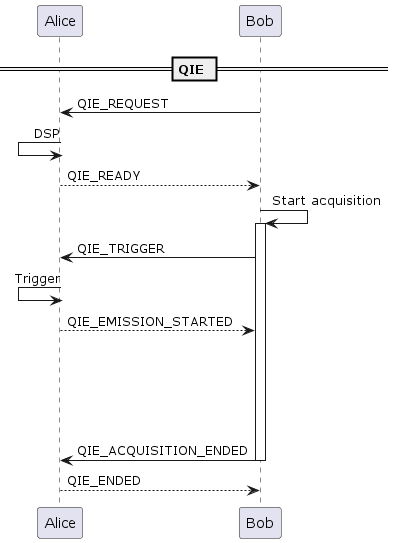
Sequence diagram from Quantum Information Exchange
QIE_REQUEST
Header
{
  "content_length": 54,
  "code": 140,
  "challenge": "challenge_requested_by_alice",
  "next_challenge": "next_challenge_for_alice"
}
Content
{
  "frame_uuid": "9f0b6ea4-9e8c-11ed-8b23-0028f86a9730",
}
QIE_READY
Header
{
  "content_length": 0,
  "code": 141,
  "challenge": "challenge_requested_by_bob",
  "next_challenge": "next_challenge_for_bob"
}
Content
No content.
QIE_TRIGGER
Header
{
  "content_length": 0,
  "code": 142,
  "challenge": "challenge_requested_by_alice",
  "next_challenge": "next_challenge_for_alice"
}
Content
No content.
QIE_EMISSION_STARTED
Header
{
  "content_length": 0,
  "code": 143,
  "challenge": "challenge_requested_by_bob",
  "next_challenge": "next_challenge_for_bob"
}
Content
No content.
QIE_ACQUISITION_ENDED
Header
{
  "content_length": 0,
  "code": 144,
  "challenge": "challenge_requested_by_alice",
  "next_challenge": "next_challenge_for_alice"
}
Content
No content.
QIE_ENDED
Header
{
  "content_length": 0,
  "code": 145,
  "challenge": "challenge_requested_by_bob",
  "next_challenge": "next_challenge_for_bob"
}
Content
No content.
Parameters estimation
Codes reserved for Parameters Estimation (PE) are 160 to 179.
Bob can request some data from Alice to finish the signal processing and compute the correlations. These points should not be used for the final key. Bob request with the PE_SYMBOLS_REQUEST with the list of indices as the content and Alice answers with PE_SYMBOLS_RESPONSE with the list of symbols corresponding to these indices as two separate list (one for the real part and one for the imaginary part). If the indices generate an out of bound error, Alice sends back PE_SYMBOLS_ERROR.
Bob can then request the number of photon (per symbol) to Alice (remember that 2PE_NPHOTON_REQUEST and Alice answers with PE_NPHOTON_RESPONSE with the mean number of photon per symbol in the content.
Then Bob sends the PE_FINISHED message containing the estimation of the transmittance, the excess noise and the value of key rate. Alice answers back with a PE_APPROVED if she wants to continue working on this frame or PE_DENIED if not. If the key rate is 0, Alice has to send the PE_DENIED.
Here is the sequence diagram:

Sequence diagram for parameters estimation
PE_SYMBOLS_REQUEST
Header
{
  "content_length": 31,
  "code": 160,
  "challenge": "challenge_requested_by_alice",
  "next_challenge": "next_challenge_for_alice"
}
Content
{
  "indices": [1, 57, 17, 90, 3]
}
PE_SYMBOLS_RESPONSE
Header
{
  "content_length": 70,
  "code": 161,
  "challenge": "challenge_requested_by_bob",
  "next_challenge": "next_challenge_for_bob"
}
Content
{
  "symbols_real": [1, 1, 1, -1, -1],
  "symbols_imag": [1, -1, 1, 1, -1]
}
PE_SYMBOLS_ERROR
Header
{
  "content_length": 73,
  "code": 162,
  "challenge": "challenge_requested_by_bob",
  "next_challenge": "next_challenge_for_bob"
}
Content
{
  "error_message": "Indice 10000 is out of bound for array of size 5000."
}
PE_NPHOTON_REQUEST
Header
{
  "content_length": 0,
  "code": 163,
  "challenge": "challenge_requested_by_alice",
  "next_challenge": "next_challenge_for_alice"
}
Content
No content.
PE_NPHOTON_RESPONSE
Header
{
  "content_length": 18,
  "code": 164,
  "challenge": "challenge_requested_by_bob",
  "next_challenge": "next_challenge_for_bob"
}
Content
{
  "n_photon": 1.54
}
PE_FINISHED
Header
{
  "content_length": 116,
  "code": 165,
  "challenge": "challenge_requested_by_alice",
  "next_challenge": "next_challenge_for_alice"
}
Content
{
  "n_photon": 1.54,
  "transmittance": 0.5,
  "excess_noise": 0.1,
  "electronic_noise": 0.05,
  "eta": 0.8,
  "key_rate": 200
}
PE_APPROVED
Header
{
  "content_length": 0,
  "code": 166,
  "challenge": "challenge_requested_by_bob",
  "next_challenge": "next_challenge_for_bob"
}
Content
No content.
PE_DENIED
Header
{
  "content_length": 37,
  "code": 167,
  "challenge": "challenge_requested_by_bob",
  "next_challenge": "next_challenge_for_bob"
}
Content
{
  "deny_message": "Key rate is null."
}
Error correction
Codes reserved for Error Correction (EC) are 180 to 199.
Bob sends a EC_INITIALIZATION with the parameters required for the error correction step. Alice can accept with EC_READY or EC_DENIED. Alice and Bob will then loop to correct every block with Bob first sending a EC_BLOCK and Alice responding EC_BLOCK_ACK if the correction worked or EC_BLOCK_ERROR if not.
At the end of this loop, there might still have some remaining errors and Bob can start another algorithm for correcting those errors with EC_REMAINING. Alice answers either with EC_REMAINING_ACK if it was successful or EC_REMAINING_ERROR if it was not.
At the end, Bob computes the hash of his key and send to Alice with the messages EC_VERIFICATION. If the hashes are equal, Alice answers with EC_VERIFICATION_SUCCESS, and if not EC_VERIFICATION_FAIL.
Here is the sequence diagram:
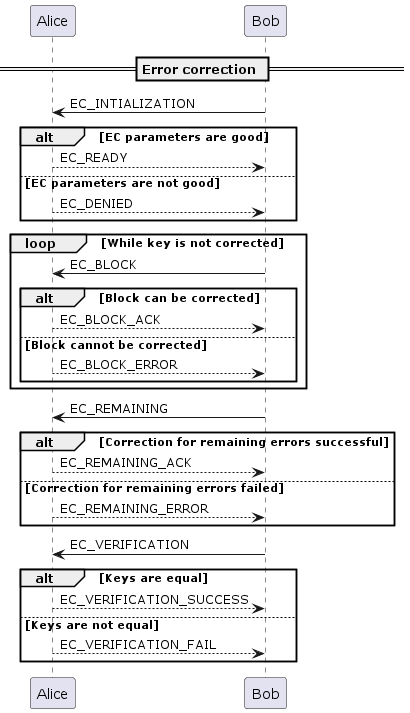
Sequence diagram for error correction
Warning
This part will probably change as the error correction algorithm is still not very defined.
EC_INITIALIZATION
Header
{
  "content_length": 42,
  "code": 180,
  "challenge": "challenge_requested_by_alice",
  "next_challenge": "next_challenge_for_alice"
}
Content
{
  "matrix": [[1,1], [1,1]],
  "noise": 0.1,
}
EC_READY
Header
{
  "content_length": 0,
  "code": 181,
  "challenge": "challenge_requested_by_bob",
  "next_challenge": "next_challenge_for_bob"
}
Content
No content.
EC_DENIED
Header
{
  "content_length": 41,
  "code": 182,
  "challenge": "challenge_requested_by_bob",
  "next_challenge": "next_challenge_for_bob"
}
Content
{
  "error_message": "Matrix is not valid."
}
EC_BLOCK
Header
{
  "content_length": 26,
  "code": 183,
  "challenge": "challenge_requested_by_alice",
  "next_challenge": "next_challenge_for_alice"
}
Content
{
  "syndrome": [1.87, 5.67,]
}
EC_BLOCK_ACK
Header
{
  "content_length": 0,
  "code": 184,
  "challenge": "challenge_requested_by_bob",
  "next_challenge": "next_challenge_for_bob"
}
Content
No content.
EC_BLOCK_ERROR
Header
{
  "content_length": 43,
  "code": 185,
  "challenge": "challenge_requested_by_bob",
  "next_challenge": "next_challenge_for_bob"
}
Content
{
  "error_message": "Wrong syndrome length."
}
EC_REMAINING
Header
{
  "content_length": 21,
  "code": 186,
  "challenge": "challenge_requested_by_alice",
  "next_challenge": "next_challenge_for_alice"
}
Content
{
  "some_parameter": 1,
}
EC_REMAINING_ACK
Header
{
  "content_length": 0,
  "code": 187,
  "challenge": "challenge_requested_by_bob",
  "next_challenge": "next_challenge_for_bob"
}
Content
No content.
EC_REMAINING_ERROR
Header
{
  "content_length": 37,
  "code": 188,
  "challenge": "challenge_requested_by_bob",
  "next_challenge": "next_challenge_for_bob"
}
Content
{
  "error_message": "Wrong parameter."
}
EC_VERIFICATION
Header
{
  "content_length": 28,
  "code": 189,
  "challenge": "challenge_requested_by_alice",
  "next_challenge": "next_challenge_for_alice"
}
Content
{
  "hash": 385789897481570657,
}
EC_VERIFICATION_SUCCESS
Header
{
  "content_length": 0,
  "code": 190,
  "challenge": "challenge_requested_by_bob",
  "next_challenge": "next_challenge_for_bob"
}
Content
No content.
EC_VERIFICATION_FAIL
Header
{
  "content_length": 40,
  "code": 191,
  "challenge": "challenge_requested_by_bob",
  "next_challenge": "next_challenge_for_bob"
}
Content
{
  "error_message": "Keys are not equal."
}
Privacy amplification
Codes reserved for Parameters Estimation (PA) are 200 to 219.
For Privacy Amplification, Bob request it by sending the PA_REQUEST along with the parameter needed to perform the privacy amplification. Alice answers with PA_SUCCESS if the privacy amplification was done successfully and PA_ERROR if there was an error.
Here is the sequence diagram:
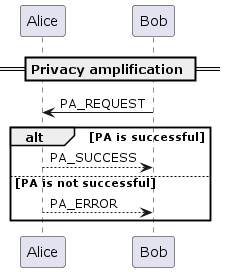
Sequence diagram for privacy amplification
PA_REQUEST
Header
{
  "content_length": 114,
  "code": 200,
  "challenge": "challenge_requested_by_alice",
  "next_challenge": "next_challenge_for_alice"
}
Content
{
  "seed": [1,0,1,1,0],
  "secret_key_length": 2000,
  "subblock_length": 5,
  "feedback_polynomial": [1,1,1,0,0],
}
PA_SUCCESS
Header
{
  "content_length": 0,
  "code": 201,
  "challenge": "challenge_requested_by_bob",
  "next_challenge": "next_challenge_for_bob"
}
Content
No content.
PA_ERROR
Header
{
  "content_length": 63,
  "code": 202,
  "challenge": "challenge_requested_by_bob",
  "next_challenge": "next_challenge_for_bob"
}
Content
{
  "error_message": "Invalid value for the feedback polynomial."
}
End of frame
Codes reserved for end of frame and end of communication are 220 to 229.
After privacy amplification, Bob confirms the end on working on a frame by sending the FRAME_ENDED, with the UUID of the frame as content and Alice answers with the FRAME_ENDED_ACK also with the UUID of the frame.
Here the sequence diagram:

Sequence diagram for end of frame
FRAME_ENDED
Header
{
  "content_length": 54,
  "code": 220,
  "challenge": "challenge_requested_by_alice",
  "next_challenge": "next_challenge_for_alice"
}
Content
{
  "frame_uuid": "9f0b6ea4-9e8c-11ed-8b23-0028f86a9730",
}
FRAME_ENDED_ACK
Header
{
  "content_length": 54,
  "code": 221,
  "challenge": "challenge_requested_by_bob",
  "next_challenge": "next_challenge_for_bob"
}
Content
{
  "frame_uuid": "9f0b6ea4-9e8c-11ed-8b23-0028f86a9730",
}
End of communication
Codes reserved for end of frame and end of communication are 220 to 229.
The graceful disconnection of the client is Bob sending DISCONNECTION and Alice answering with DISCONNECTION_ACK.
Here is the sequence diagram

Sequence diagram for end of communication
DISCONNECTION
Header
{
  "content_length": 0,
  "code": 222,
  "challenge": "challenge_requested_by_alice",
  "next_challenge": "next_challenge_for_alice"
}
Content
No content.
DISCONNECTION_ACK
Header
{
  "content_length": 54,
  "code": 223,
  "challenge": "challenge_requested_by_bob",
  "next_challenge": "next_challenge_for_bob"
}
Content
No content.
Parameter change
Codes 50 to 69 are reserved for parameter change.
When Bob wants Alice to change a parameter, Bob sends a CHANGE_PARAMETER_REQUEST with the name of the parameter and the requested value in the content.
Alice has then four possible answers:
PARAMETER_CHANGED: she has accepted the change. The name of the parameter, the old value and the new value should be in the content.PARAMETER_UNKOWN: Alice didn’t find the parameter. The name of the parameter should be in the content.PARAMETER_INVALID_VALUE: Alice found the parameter, but the requested value either makes no sense for this parameter or is out of the possible range for Alice. The name of the parameter and the old value should be in the content. An error message can also be in the content to give more information on the non-validity of the value.PARAMETER_UNCHANGED: Alice found the parameter and the value is a valid value. However, due to policy, Alice didn’t change the value of the parameter. The name of the parameter and the old value should be in the content. An error message giving more information can also be added.
Here is the diagram sequence for the parameter change:

Sequence diagram for parameter change
CHANGE_PARAMETER_REQUEST
Header
{
  "content_length": 48,
  "code": 50,
  "challenge": "challenge_requested_by_alice",
  "next_challenge": "next_challenge_for_alice"
}
Content
{
  "parameter": "qi.frame.roll_off",
  "value": 0.3
}
PARAMETER_CHANGED
Header
{
  "content_length": 70,
  "code": 51,
  "challenge": "challenge_requested_by_bob",
  "next_challenge": "next_challenge_for_bob"
}
Content
{
  "parameter": "qi.frame.roll_off",
  "old_value": 0.5,
  "new_value": 0.3
}
PARAMETER_UNKOWN
Header
{
  "content_length": 34,
  "code": 52,
  "challenge": "challenge_requested_by_bob",
  "next_challenge": "next_challenge_for_bob"
}
Content
{
  "parameter": "qi.frame.roll_olf",
}
PARAMETER_INVALID_VALUE
Header
{
  "content_length": 52,
  "code": 53,
  "challenge": "challenge_requested_by_bob",
  "next_challenge": "next_challenge_for_bob"
}
Content
{
  "parameter": "qi.frame.roll_off",
  "old_value": 0.5,
}
PARAMETER_UNCHANGED
Header
{
  "content_length": 52,
  "code": 54,
  "challenge": "challenge_requested_by_bob",
  "next_challenge": "next_challenge_for_bob"
}
Content
{
  "parameter": "qi.frame.roll_off",
  "old_value": 0.5,
}
Polarisation recovery
Codes 70 to 79 are reserved for polarisation recovery.
When Bob wants to start the polarisation recovery, he sends REQUEST_POLARISATION_RECOVERY, and Alice should start the emission of the classical signal and respond with POLARISATION_RECOVERY_ACK. Bob should then perform the polarisation recovery algorithm and when done, send the END_POLARISATION_RECOVERY and Alice should stop the classical signal and respond POLARISATION_RECOVERY_ENDED.
Here is the diagram sequence for the polarisation recovery:

Sequence diagram for parameter change
REQUEST_POLARISATION_RECOVERY
Header
{
  "content_length": 0,
  "code": 70,
  "challenge": "challenge_requested_by_bob",
  "next_challenge": "next_challenge_for_bob"
}
Content
No content.
POLARISATION_RECOVERY_ACK
Header
{
  "content_length": 0,
  "code": 71,
  "challenge": "challenge_requested_by_bob",
  "next_challenge": "next_challenge_for_bob"
}
Content
No content.
END_POLARISATION_RECOVERY
Header
{
  "content_length": 0,
  "code": 72,
  "challenge": "challenge_requested_by_bob",
  "next_challenge": "next_challenge_for_bob"
}
Content
No content.
POLARISATION_RECOVERY_ENDED
Header
{
  "content_length": 0,
  "code": 73,
  "challenge": "challenge_requested_by_bob",
  "next_challenge": "next_challenge_for_bob"
}
Content
No content.
Other messages
The codes reserved for this other messages is 10-49.
UNKNOWN_COMMAND
Alice should answer with an UNKOWN_COMMAND if the provided command was unknown (i.e. is not a command in the description of the protocol). It should return the code that was issued.
Header
{
  "content_length": 14,
  "code": 10,
  "challenge": "challenge_requested_by_bob",
  "next_challenge": "next_challenge_for_bob"
}
Content
{
  "code": 1000
}
UNEXPECTED_COMMAND
Alice should answer an UNEXPECTED_COMMAND if the command asked by Bob exist but doesn’t make sense in the current context. The code of the required command should be provided. An optional error message can also be issued.
HEADER
{
  "content_length": 14,
  "code": 11,
  "challenge": "challenge_requested_by_bob",
  "next_challenge": "next_challenge_for_bob"
}
Content
{
  "code": 200,
  "error_message": "Privacy amplification cannot be donne before error correction."
}
INVALID_CONTENT
Alice should answer INVALID_CONTENT if the content in the request is not valid valid according to the current specification. The code of the requested command should be given, along with an optional error message.
Header
{
  "content_length": 14,
  "code": 12,
  "challenge": "challenge_requested_by_bob",
  "next_challenge": "next_challenge_for_bob"
}
Content
{
  "code": 200,
  "error_message": "Seed parameter was not present in the content."
}
INVALID_RESPONSE
If Bob receives an invalid response to one of its request (the code is not part of the ones he expect, or the content was malformed), he sends to Alice an INVALID_RESPONSE. An optional error_message can be passed. Alice should respond with an INVALID_RESPONSE_ACK. After that, Bob will probably have to disconnect.
Header
{
  "content_length": 60,
  "code": 13,
  "challenge": "challenge_requested_by_alice",
  "next_challenge": "next_challenge_for_alice"
}
Content
{
  "error_message": "Code 221 made no sense in this context."
}
INVALID_RESPONSE_ACK
Header
{
  "content_length": 0,
  "code": 14,
  "challenge": "challenge_requested_by_bob",
  "next_challenge": "next_challenge_for_bob"
}
Content
No content.
ABORT
If at any point Bob wants to abort the current frame, he sends an ABORT message. The message can contain an optional message to explain decision. Alice should answer with an ABORT_ACK.
This doesn’t mean that Bob is going down. If he wants to end the communication gracefully, he stills need an DISCONNECTION message. However, it means that all the work on the current frame should be deleted.
If Alice wants to abort, she answered to any Bob message with ABORT and Bob should abort immediately.
Header
{
  "content_length": 40,
  "code": 15,
  "challenge": "challenge_requested_by_alice",
  "next_challenge": "next_challenge_for_alice"
}
Content
{
  "abort_message": "Physical tempering."
}
ABORT_ACK
Alice answers back to Bob with ABORT_ACK when she receives an ABORT message.
Header
{
  "content_length": 0,
  "code": 16,
  "challenge": "challenge_requested_by_bob",
  "next_challenge": "next_challenge_for_bob"
}
Content
No content.
AUTHENTICATION_INVALID
If at some point Bob notices an invalid authentication from Alice, he do again the authentication part (after a specific amount of failure, Bob concludes to a man in the middle attack).
If Alice notices an invalid authentication with one of Bob’s message, she sends AUTHENTICATION_INVALID and Bob should do again the authentication part. After a certain number of authentication failures, Alice concludes to a man in the middle attack.
Header
{
  "content_length": 0,
  "code": 17,
  "challenge": "challenge_requested_by_bob",
  "next_challenge": "next_challenge_for_bob"
}
Content
No content.
Error codes
Low layers can return error codes that are directly communication codes. They indicate to higher application layers that something went wrong when receiving the frame but it doesn’t raise an exception.
The error codes are:
SOCKET_DISCONNECTION = -1: other party has disconnected;FRAME_ERROR = -2: there was an error reading the frame (non valid JSON, missing header value, frame too short);AUTHENTICATION_FAILURE = -3: there was an error while verifying the integrity and/or the authentication of the message;UNKOWN_CODE = -4: the given code is not a valid QOSST code.
Full sequence diagram
The full sequence diagram is given below:

Full sequence diagram
List of codes
Enumeration of the QOSST/0.2 protocol.
- class qosst_core.control_protocol.codes.QOSSTCodes(value, names=None, *, module=None, qualname=None, type=None, start=1, boundary=None)
Codes for the QOSST/0.2 protocol.
- UNKOWN_COMMAND = 10
Code for an unkown command.
- UNEXPECTED_COMMAND = 11
Code for an unexpected command.
- INVALID_CONTENT = 12
Code indicating that the content was invalid.
- INVALID_RESPONSE = 13
Code indcating an invalid response.
- INVALID_RESPONSE_ACK = 14
Code to acknowledge an invalid reponse message.
- ABORT = 15
Abort code.
- ABORT_ACK = 16
Acknowledge an abortion code.
- AUTHENTICATION_INVALID = 17
Indicate that an authentication message was invalid.
- CHANGE_PARAMETER_REQUEST = 50
Code to request a change of parameter.
- PARAMETER_CHANGED = 51
- PARAMETER_UNKOWN = 52
- PARAMETER_INVALID_VALUE = 53
Code to answer to a parameter change request if the requested value is invalid.
- PARAMETER_UNCHANGED = 54
Code to answer to a parameter change request saying that the parameter was not changed.
- REQUEST_POLARISATION_RECOVERY = 70
- POLARISATION_RECOVERY_ACK = 71
- END_POLARISATION_RECOVERY = 72
- POLARISATION_RECOVERY_ENDED = 73
- IDENTIFICATION_REQUEST = 100
Request the start of the identification process.
- IDENTIFICATION_RESPONSE = 101
Response to a request of identification.
- INVALID_QOSST_VERSION = 102
Response to answer to an identification request if the versions of the QOSST protocols are not compatible.
- INITIALIZATION_REQUEST = 120
Request the start of the initialization process.
- INITIALIZATION_ACCEPTED = 121
Accept the initialization (i.e. configuration).
- INITIALIZATION_DENIED = 122
Deny the initialization (i.e. configuration).
- INITIALIZATION_PROPOSAL = 123
Propose a configuration.
- INITIALIZATION_REQUEST_CONFIG = 124
Request a configuration.
- INITIALIZATION_CONFIG = 125
Send the configuration for the initialization.
- QIE_REQUEST = 140
Request the start of the Quantum Information Exchange process.
- QIE_READY = 141
Notify that the quantum information is ready to be sent.
- QIE_TRIGGER = 142
Start the quantum information exchange.
- QIE_EMISSION_STARTED = 143
Notify that the emission has started.
- QIE_ACQUISITION_ENDED = 144
Notify that the acquisition has ended.
- QIE_ENDED = 145
End the QIE process.
- PE_SYMBOLS_REQUEST = 160
Request some symbols to Alice.
- PE_SYMBOLS_RESPONSE = 161
Answer to the request of symbols.
- PE_SYMBOLS_ERROR = 162
Answer to the request of symbols if there was an error to to generate the response (i.e. invalid indices).
- PE_NPHOTON_REQUEST = 163
Request the average photon number of Alice.
- PE_NPHOTON_RESPONSE = 164
Response to the request of the average photon number.
- PE_FINISHED = 165
Notify that parameter estimation is finished and send the parameters to Alice.
- PE_APPROVED = 166
- PE_DENIED = 167
Deny the estimated parameters and abort.
- EC_INITIALIZATION = 180
- EC_READY = 181
- EC_DENIED = 182
- EC_BLOCK = 183
- EC_BLOCK_ACK = 184
- EC_BLOCK_ERROR = 185
- EC_REMAINING = 186
- EC_REMAINING_ACK = 187
- EC_REMAINING_ERROR = 188
- EC_VERIFICATION = 189
- EC_VERIFICATION_SUCCESS = 190
- EC_VERIFICATION_FAIL = 191
- PA_REQUEST = 200
- PA_SUCCESS = 201
- PA_ERROR = 202
- FRAME_ENDED = 220
End a frame.
- FRAME_ENDED_ACK = 221
ACK message for a end of frame.
- DISCONNECTION = 222
Notify the other party of a disconnection.
- DISCONNECTION_ACK = 223
ACK for the disconnection message.
- class qosst_core.control_protocol.codes.QOSSTErrorCodes(value, names=None, *, module=None, qualname=None, type=None, start=1, boundary=None)
Error codes for QOSST.
- SOCKET_DISCONNECTION = -1
Indicate that the other party has disconnected
- FRAME_ERROR = -2
The frame was not well formatted
- AUTHENTICATION_FAILURE = -3
There was an authentication failure (either with the challenge wrong or not present, or on the signed digest)
- UNKOWN_CODE = -4
The sent code is not in the possible QOSST codes.